The History of 8 Hours Til Dawn...
2009: The Everything-Zombie-Game That Wasn't.
It started with disappointment. My friends Lucas, Jake, and I had just bought what we thought would be the perfect zombie board game. We cracked open the box, marveled at all the components, thumbed through the thick rulebook, and felt that electric excitement of discovery. Then we played it. It was awful.
But instead of shelving it and moving on, we decided we could do better. We spent 24 hours brainstorming our own zombie survival game, and promptly made every mistake first-time designers make. We wanted everything.
Minigames inside the main game.
Find a car on the road?
Play a separate minigame to figure out what parts it needs.
Then go scavenging for those parts
Roof collapse
Car alarms attracting hordes
Building a home base
We were young and ambitious.
This was before Dead of Winter showed everyone how to capture scavenging tension without drowning players in subsystems. The project collapsed under its own weight almost immediately. But something stuck with me from that failed experiment: I wanted to make a board game that was fun while capturing the feeling of proving yourself in a zombie apocalypse. That seed would take 16 years to fully bloom.
2011-2013: First Light, Then Darkness.
A few years later, I started designing what would become 8 Hours Til Dawn. I salvaged mechanics from that 2009 fever dream, things that seemed fun in theory but hadn't survived contact with actual players.
I had:
A barricade system (players could fortify windows against the horde)
A day/night cycle (venture out during daylight to scavenge supplies)
Active character abilities
A vision for realistic gritty artwork
I had a game.
It was kind of fun. I could see the light at the end of the tunnel. But everyone I was playtesting with got burnt out. The barricade system was convoluted. The day/night cycle made sessions drag on forever. The game was functional, but it wasn't compelling.
8 Hours Til Dawn went on the shelf. I walked away from it. But during those years, I kept playing board games. Lots of them. I watched the industry evolve. Games got more expensive, more bloated. I started noticing which ones actually hit the table repeatedly, and why. The lessons were piling up. I just didn't know it yet.
2014: Lightning Strikes at ACen
In 2014 Lucas and I attended ACen, an anime convention in Chicago. Among the cosplayers and artist alleys, a friend brought a game to our hotel room: Space Alert. I fell in love immediately. Space Alert is a cooperative game where players frantically program their actions under a time limit, then watch their plan execute and usually fall apart spectacularly. It's chaosm, It's hilarious. It's stressful, in exactly the right way.
This was it.
This was what 8 Hours Til Dawn needed.
But I also recognized what Space Alert didn't offer: accessibility. At the time the other freinds I played games with wouldn't want to wrestle with Space Alert's complexity just to watch their plans crumble. I wanted to give them that timer-based panic without the overwhelming learning curve. Within a week of returning from ACen, I picked 8HTD back up. The late-night playtesting marathons with Dickie, Jake, and Lucas began.
2015: The Second Burnout and the Mathematical Breakthrough
At first, I tried too hard to replicate Space Alert. I borrowed the programmed movement system, players lay out their actions in advance, then resolve them one by one, but I kept the timer running constantly.
During planning.
During execution.
Everywhere.
It didn't work. The game felt chaotic instead of tense, exhausting instead of thrilling. So I stripped it back. I kept the programmed movement, I'd converted Space Alert's fiddly tokens into cards, which felt cleaner, but I cut the timer to find where it actually belonged. Eventually, I discovered the answer:
the timer only mattered during the planning phase. I didn't need it to run the whole game even though Space Alert did that.
This changed everything. Players had to make imperfect decisions under pressure while laying out their 8 cards. Then they watched their flawed plans execute deliberately during the action phase. That's actual horror pacing: frantic preparation, followed by helpless observation as consequences unfold. The win rate dropped. The game stopped being a solvable puzzle and became an experience. A frantic yelling match about who gets to kill which infected while the horde presses closer. But my playtesters burned out again in 2015. Not because the game was bad, it was finally fun, but because we'd been grinding on it for so long. Everyone was exhausted.
Everyone except me.
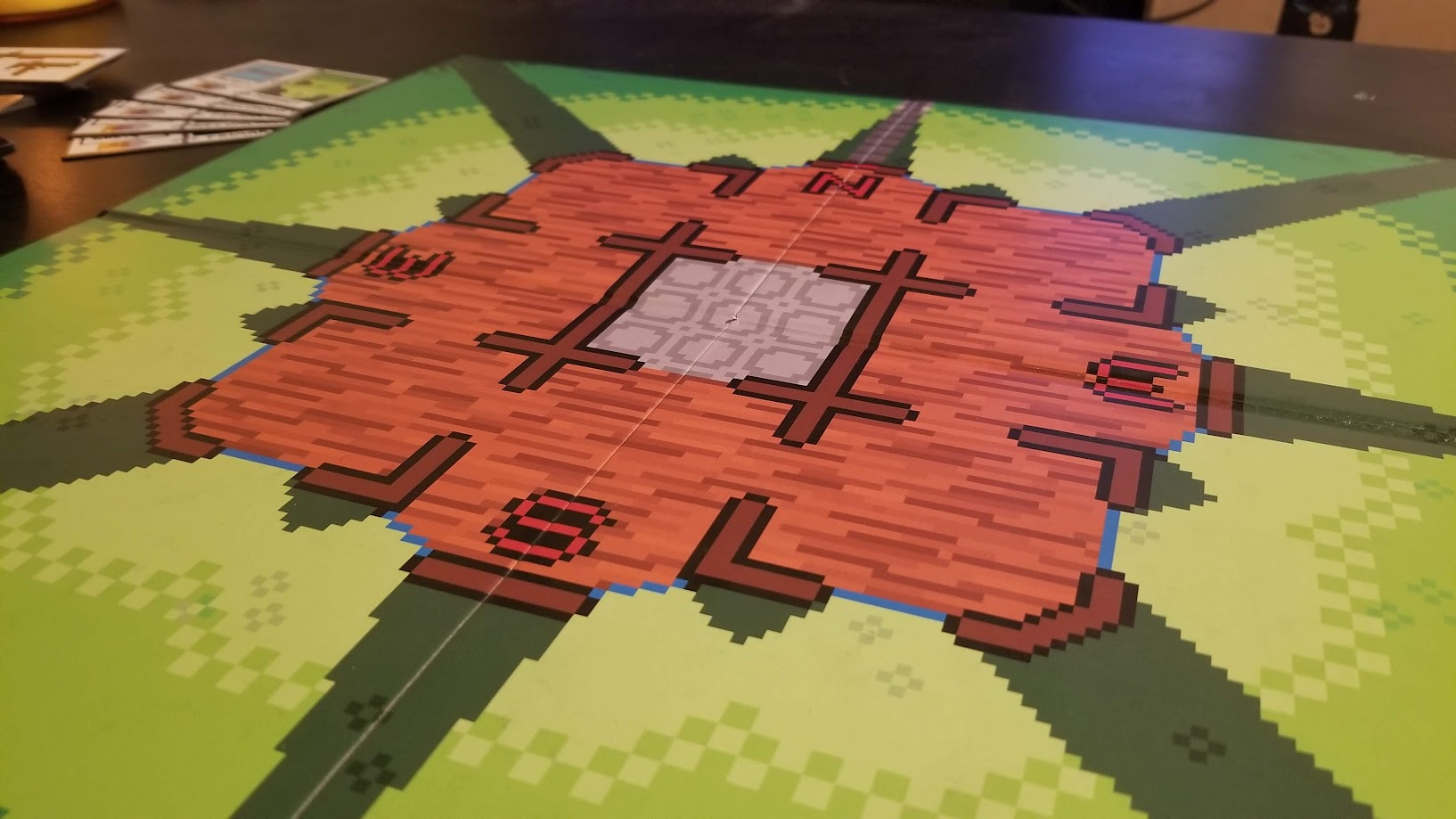
So I kept working. I stripped the game down to pure numbers and variables. I needed to understand what was making it too easy in some configurations, too hard in others. That's when I noticed something remarkable: the number 8 kept appearing as the natural balance point. So I leaned into it 8 hours until dawn, 8 action cards per turn, An 8-sided die, 8 rooms on the game board, 8 survivors, 8 of each card. I used 8 as a constraint, tried to force everything to align with that number. Some things worked beautifully. Others, like giving every gun exactly 8 ammo, made the weapons feel samey and boring.
When the pure "8s everywhere" approach hit its limits, I discovered another tool: Magic: The Gathering's "3-mana bear" rule, the principle that a 2/2 creature for 3 mana is the baseline, and everything else is measured against that standard. I could apply this to 8 Hours Til Dawn. Character traits could be balanced as net-zero (a positive trait matched with an equivalent negative trait). Weapons could trade higher kill counts for worse hit numbers or fewer bullets. The two frameworks, the "8" constraint and the bear rule, worked together as a closed system. This is when the math clicked.
2015-2016: From Pop Art to Pixels
I'd originally envisioned 8 Hours Til Dawn with realistic artwork, then shifted to an 80s pop art aesthetic inspired by Night of the Living Dead The biggest inspiration for this game. But pop art was time-intensive, and in the mid-2010s, playtest culture demanded "nice enough" presentation. Nobody wanted to test a game that looked like a crude prototype. I needed something quick. Pixel art became my placeholder solution. I'd just bought Aseprite and was excited to use it.
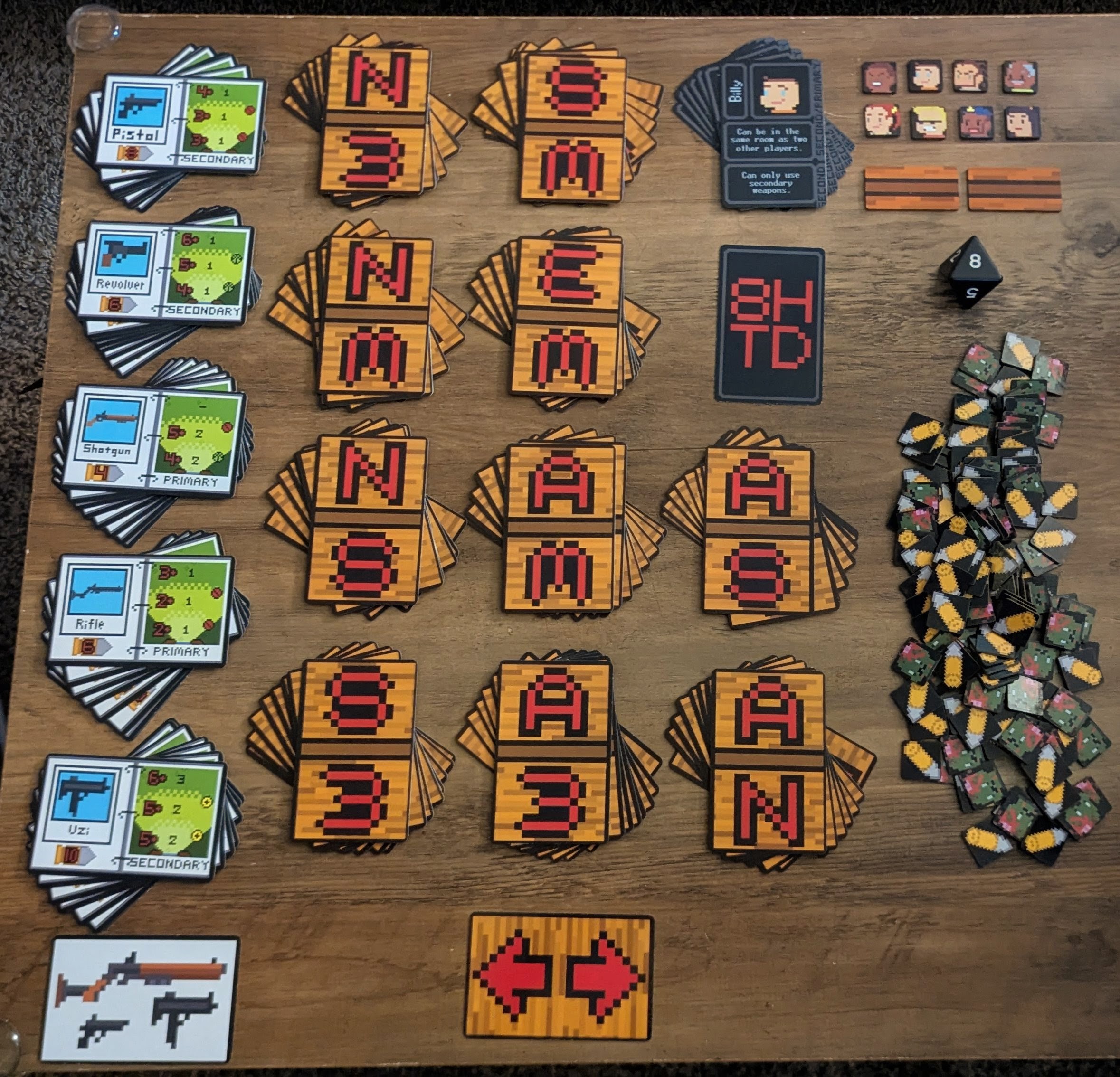
I needed a starting point for the character layout, so I made the first survivor, Duke, as a pixel art homage to Duke Nukem. The joke worked: a video game action hero rendered as a "normal dude" in this survival horror context. It was funny, recognizable, and it opened the door to other campy references across the game as well. I created the zombie tokens. The bullet tokens. The other seven survivors some as throwbacks to horror games and movies, some with Easter eggs like Billy (a nod to "Billy the Kid" as a scared youngster among grizzled survivors). What started as a placeholder became the definitive art style. The pixel art wasn't just budget-friendly, it was perfect for the game. Instantly readable during timed gameplay. Thematically reinforced the "8-bit" connection to the number 8. Gave the game a distinctive identity that avoided the "generic zombie game" visual trap. The pop art vision had been good. The pixel art was Perfect.
2016-2019: 60-90 Playtests and Proven Balance
With finalized pixel art good to go, I kept playtesting with crude paper prototypes. I didn't want to pay for tokens and printed components until the mechanics were absolutely locked. It seems counterintuitive, I wanted to make sure the game was fun before making it actually pretty. Over these three years, I ran about 50 playtests. I tracked win rates across all player counts. I tested three difficulty levels. I refined rules, streamlined language, removed ambiguities. The math held. The "8" framework and the bear rule kept everything balanced even as I added content and made adjustments. I consistently hit around a 50% win rate, the sweet spot where players felt challenged but not hopeless. At the beginning of 2019, I finally ordered a professional copy from The Game Crafter. Now I had a beautiful version to show outside playtesters. The game was mechanically complete. It worked. It was good.
2020: Life Happens (Again)
Then COVID-19 hit, and my first child was born.
The game went back on the shelf, this time for four years. But unlike the previous shelf periods, this time the game was done. The mechanics were proven. The balance was locked in. It just needed to get the rulebook written in a way that was easily understood without me sitting there telling you what I meant and to wait for the right moment to re-emerge.
2025: The Empire Revealed
When I picked 8 Hours Til Dawn up again in 2025, I wasn't redesigning,I was packaging. A few more playtests confirmed nothing had broken during the shelf period. The game still worked exactly as intended and was still fun. My focus shifted to marketability:
polishing the rulebook I had been slowly fixing over the last five years
Building a Tabletop Simulator mod for remote playtesting,
Creating this website,
Preparing publisher pitch materials.
But as I worked on these finishing touches, I had a revelation about what I'd actually built. All those failed mechanics from earlier iterations, barricades, day/night scavenging, trading, hadn't been wrong. They'd been misplaced. They didn't belong in the base game, but they could work brilliantly as expansions.
Not only expansions but I could make them play like defining media in the infected history, lore, whatever you want to call it.
All the other Characters and weapons? Perfect for a Dead Rising-style expansion where you just want MORE.
The barricade system that cluttered the core experience?
The trading system that made the base game too easy?
Ideal for a mall expansion capturing the Left 4 Dead 2 feeling of even more Team work,
Resource runs during the day and survival at night. If you combine them all together with the base game and some slight rule adjustments. Just Like the the main parts of that original everything zombie game
I realized I hadn't just built a game, I'd built a game engine. A modular system where each major expansion could stand alone, combine with other expansions, or layer onto the base game to create increasingly complex experiences. And it wasn't limited to zombies. The core mechanics, threats advancing in waves, time pressure, resource scarcity, spatial constraints, asymmetric abilities, could support the entire horror genre. Werewolves. Aliens. Ghosts. Slashers. As long as I followed the bear-rule balancing principle and respected the core framework, I could create an entire horror game ecosystem. Each major expansion could be themed after a different touchstone in zombie (and later, horror) media:
Base game 8 Hours Til Dawn = Night of the Living Dead (slow zombies, cramped house, claustrophobic dread)
Mall expansion = Day of the Dead standalone, or Left 4 Dead 2 when combined with barricades and the base game.
Future expansions = 28 Days Later (already have a alternative play in the rulebook for the base game), World War Z, The Walking Dead each with their own mechanical identity.
This wasn't just a game anymore. It was the foundation of an empire, the "everything-zombie-game" I'd tried to build in 2009, except this time done right.
Modular.
Scalable.
Elegant.
Today: Ready to Prove It
Sixteen years after that first failed attempt, 8 Hours Til Dawn is complete. The mechanics are proven through extensive playtesting. The 50% win rate holds across all player counts and difficulty levels. The art is finalized. The expansion roadmap is architected. The rulebook is polished. But I'm not done yet. Before I pitch to publishers, I want more playtest data. More feedback from fresh eyes. More confirmation that the rules communicate clearly and the experience delivers what it promises. That's where you come in.
Join the Final Playtest
I'm building a Tabletop Simulator mod so anyone can experience 8 Hours Til Dawn right now, no physical prototype needed. I'm gathering playtesters who want to:
Try the game and feel the panic when the timer expires and your plan isn't quite ready
Give feedback on rule clarity, balance questions, or anything that feels off
Be part of the story as this 16-year journey finally crosses the finish line
If you're a board gamer who loves cooperative survival, timer-based tension, or zombie horror, I want to hear from you.
Sign up for playtest access You'll get:
Early access to the TTS mod
Direct line to share feedback with the designer (Me)
First look at publisher announcements and development updates
The satisfaction of knowing you helped prove a game that's been 16 years in the making
The night is almost over.
Dawn is coming.
Will you survive with us?
-Jeff's Junk Shop
Creator of 8 Hours Til Dawn